
Gemini 4 Carbon, Anthropic Claude 5.2 & Adobe AI
Google and Anthropic have launched their latest model lineups, highlighting new capabilities for autonomous agents and enterprise cybersecurity. Meanwhile, Adobe and Meta are pushing agentic workflows deeper into creative and consumer platforms as industry forecasts project surging enterprise spending.
13 stories85 sources checked
Listen to this edition
PiBrief Tech, November 11, 2026
The lineup
In this edition
 01
Google Launches Gemini 4 Carbon and /swarm for Advanced AI Workflows
 02
Anthropic Releases Claude Fable 5.2 and Mythos 5.2 for Enterprise and Cybersecurity
 03
Adobe MAX 2026 Shifts Creative Cloud to Agentic Workflows, Integrates Local AI
 04
Disney and Adobe Forge AI Partnership for Custom Generative Models
 05
Meta Introduces Muse Ember AI and Smartwatch Agent Integration
 06
IBM and Microsoft Partner on Imagine Enterprise for Autonomous Agents in Regulated Industries
 07
Meta's Muse Ember 1.0 Targets Cost Efficiency in Agent Workflows
 08
AI100 Report: Generative AI Pivots from Scale to Inference, Reasoning, and Scientific Impact
 09
Omdia Forecasts AI Software Revenue to Surpass $200 Billion in 2026, Driven by Agentic Systems
- 10
New York Launches Center for AI Responsibility to Audit Frontier Models
- 11
Zingtree Launches Hybrid AI Governance for Regulated Finance
 12
InDebted's 'Voice' AI Agent Boosts Debt Recovery by Doubling Payment Adherence
- 13
Enterprise AI Focuses on ROI and Governance Amid Deployment Challenges
See all 13 as a listHide the list
- Google Launches Gemini 4 Carbon and /swarm for Advanced AI Workflows
- Anthropic Releases Claude Fable 5.2 and Mythos 5.2 for Enterprise and Cybersecurity
- Adobe MAX 2026 Shifts Creative Cloud to Agentic Workflows, Integrates Local AI
- Disney and Adobe Forge AI Partnership for Custom Generative Models
- Meta Introduces Muse Ember AI and Smartwatch Agent Integration
- IBM and Microsoft Partner on Imagine Enterprise for Autonomous Agents in Regulated Industries
- Meta's Muse Ember 1.0 Targets Cost Efficiency in Agent Workflows
- AI100 Report: Generative AI Pivots from Scale to Inference, Reasoning, and Scientific Impact
- Omdia Forecasts AI Software Revenue to Surpass $200 Billion in 2026, Driven by Agentic Systems
- New York Launches Center for AI Responsibility to Audit Frontier Models
- Zingtree Launches Hybrid AI Governance for Regulated Finance
- InDebted's 'Voice' AI Agent Boosts Debt Recovery by Doubling Payment Adherence
- Enterprise AI Focuses on ROI and Governance Amid Deployment Challenges
Story 1 of 13
3 min read
Google Launches Gemini 4 Carbon and /swarm for Advanced AI Workflows
Google has made Gemini 4 Carbon, its advanced reasoning model for agentic workflows and cybersecurity, generally available through its API and AI services. Alongside this, Google introduced /swarm, an agent orchestration system within its Antigravity developer environment, designed to coordinate multiple specialized AI models from a single prompt. Gemini 4 Carbon boasts a 1-million-token context window and multimodal capabilities, positioning it as a leader in AI benchmarks.
Read the full storyFold the full story2 min · 15 sources
Google officially expanded general availability for Gemini 4 Carbon, its flagship reasoning model engineered for long-horizon agentic workflows, vulnerability research, and multi-subsystem engineering tasks[1][2][3]. First revealed in late October under limited access for defense specialists in the Fairwind Program, Gemini 4 Carbon is now available to developers and enterprises via the paid tier of the Gemini API in Google AI Studio, Android Studio, and Gemini for Business[1][4][5]. The model has also rolled out directly to Google AI Ultra subscribers across the Gemini mobile app, Google Antigravity, and AI Mode in Google Search[6][7][6]. Concurrently, Google launched a public preview of `/swarm` inside its Antigravity developer environment, an agentic orchestration system designed to coordinate teams of specialized models from a single user prompt[8][9][5].
Gemini 4 Carbon is architected as an extended-thinking iteration of Gemini 4 Argon, supporting a 1-million-token context window and multimodal ingestion across text, imagery, video, audio, and complex PDF documents[10][1]. To compete directly with recent frontier releases, Google instituted an aggressive introductory pricing structure through November 30, 2026: $2.00 per million input tokens and $10.00 per million output tokens - including internal reasoning and verification tokens - before rates adjust to $4.00 and $20.00 respectively on December 1[10][7][11]. The model's knowledge cutoff is March 2026[10][12]. The rollout arrived alongside immediate day-one ecosystem integrations, including general availability in GitHub Copilot (accessible across Pro+, Max, Business, and Enterprise plans)[13] and implementation within Cognition’s autonomous engineering platform, Devin[14].
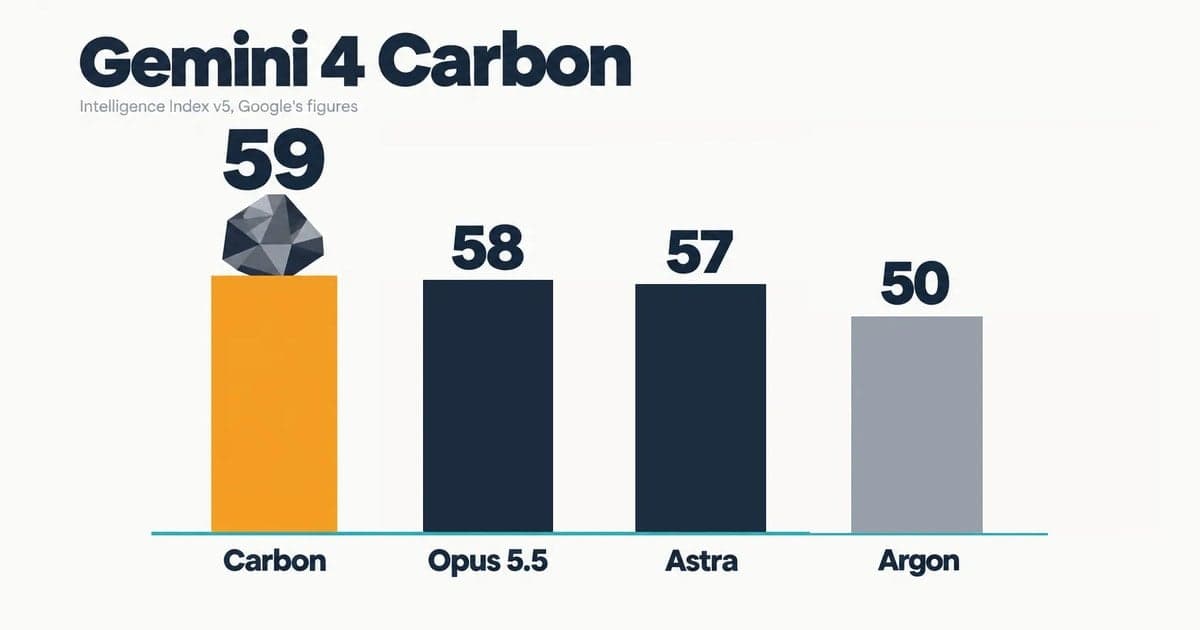
On capability metrics, Google’s leadership - spearheaded by SVP of Google DeepMind and Chief AI Architect Koray Kavukcuoglu alongside Sundar Pichai - reported that Gemini 4 Carbon leads the Artificial Analysis Intelligence Index v5 with a composite score of 59, surpassing Claude Opus 5.5 (58) and OpenAI’s GPT-6 Astra (57)[2][3]. In independent engineering evaluations conducted by Cognition, Gemini 4 Carbon notched a 40.0% solve rate on FrontierCode 2.0 in Devin Desktop and CLI, marking a steep climb from Argon’s 26.3% and outstripping GPT-6.1 Sol’s 39.0% at lower cost per task[14]. In benchmark suites measuring autonomous tool execution and workflow synthesis, Carbon registered top scores on CursorBench 4.0 and Zapier’s AutomationBench[7][3]. On cybersecurity evaluations conducted through the Fairwind framework, Carbon posted 88.2% on SEC-bench Pro, 71.0% on CWE-bench, and 54.8% on ExploitGym, with internal Google safety teams noting it successfully blocked 99% of simulated attacks in ExploitBench and CyScenarioBench environments[15][2].
The accompanying launch of `/swarm` within Google Antigravity introduces an operational model for large-scale code synthesis[8][3]. Instead of funneling an expansive codebase through a single sequential context window, `/swarm` splits incoming prompts into a coordinator agent that provisions distinct worker agents working inside isolated Git worktrees to prevent code collisions[5]. Workers communicate asynchronously via an append-only shared ledger while adversarial verifiers evaluate pull requests and unit test integrity[5]. Google positions Gemini 4 Carbon as the primary coordinating and auditing intelligence within `/swarm`, while delegating faster subtasks to lighter models[1][5]. While developer commentary has praised Carbon's ability to run multi-hour verification loops across full-stack applications, enterprise adopters have pointed out that reasoning-heavy tokens can rapidly consume API quotas, highlighting the financial trade-offs of autonomous verification loops[10][9].
- Gemini 4 Carbon
- /swarm
Story 2 of 13
2 min read
Anthropic Releases Claude Fable 5.2 and Mythos 5.2 for Enterprise and Cybersecurity
Anthropic has deployed Claude Fable 5.2 and Claude Mythos 5.2, its latest frontier AI models, across major cloud platforms and native services. Fable 5.2 is designed for general-purpose tasks with safety guardrails, while Mythos 5.2 is an unconstrained version for specialized cybersecurity and defense applications. Both models feature enhanced speed, a 1-million-token context window, and improved performance on coding and security benchmarks.
Read the full storyFold the full story2 min · 9 sources
Anthropic expanded the deployment footprint of its newest frontier AI duo, Claude Fable 5.2 and Claude Mythos 5.2, bringing high-end reasoning systems into developer channels, major cloud providers, and enterprise cybersecurity workflows[1][2][3]. Built from the same underlying foundation model, the system is segmented along safety and alignment lines: Claude Fable 5.2 operates as the general-purpose flagship with full safety guardrails for coding, research, and long-horizon agents, while Claude Mythos 5.2 is an unconstrained deployment reserved exclusively for vetted cybersecurity teams, research institutions, and defense partners[1][4][2]. Both models arrived across Amazon Web Services, Google Cloud, and Microsoft Azure, in addition to native Claude web, mobile, and API surfaces[1][3].
Technically, the 5.2 architecture is tailored to autonomous software engineering and scientific reasoning, generating tokens up to 30% faster than its 5.1 predecessors while introducing an optional "fast mode" that accelerates generation up to 2.5 times[5][2][3]. The standard API tier is priced at $8.00 per million input tokens and $40.00 per million output tokens (with the high-speed tier running at $16.00 and $80.00), representing a 20% price reduction compared to 5.1-era pricing[6][2][3]. The model family features a 1-million-token context window and recorded a 49.1% score on FrontierCode 2.0 at maximum reasoning effort, alongside 69.9% on FrontierSWE v2[6]. Anthropic also shared research milestones achieved during testing, stating the base model formalized the proof of Fermat’s Last Theorem within a 30-hour computing budget and resolved two long-standing open problems in the theoretical physics of black holes[5].
The practical divergence between the two models centers on cyber defensive capabilities and alignment tuning[4][7]. Claude Fable 5.2 incorporates safety classifiers that actively restrict exploit generation and biochemical synthesis, though early benchmarks reveal it blocked 55% fewer benign technical requests than earlier builds, significantly easing developer friction[4]. Mythos 5.2, meanwhile, has been integrated directly into specialized enterprise platforms[8]. Cognition announced that Claude Mythos 5.2 is now powering Devin Security for enterprise vulnerability auditing, committing over $100 million in credits for enterprises to stress-test their software[8]. In Cognition's multi-repository security benchmark spanning 1,781 real-world vulnerabilities across 25 production codebases (covering C, Go, Python, and TypeScript), Mythos 5.2 achieved an F2 score of 73.5, more than double Claude Opus 5.5's 32.7 and substantially ahead of Mythos 5.1’s 56.9[8].
Industry reaction reflects a hardening divide in frontier AI deployment, where frontier models are bifurcated between consumer-safe interfaces and restricted red-teaming utilities[9][7]. Security analysts have praised Mythos’s ability to pinpoint subtle multi-file memory leaks and logic vulnerabilities without running into defensive refusals, while enterprise developers have welcomed Fable’s reduced latency on production code generation[4][2]. The launch has sharpened competition at the apex of the model market, pushing frontier labs into a cycle of simultaneous capability upgrades and targeted domain restrictions[5][7].
- Anthropic
- Claude Fable 5.2
- Claude Mythos 5.2
Story 3 of 13
2 min read
Adobe MAX 2026 Shifts Creative Cloud to Agentic Workflows, Integrates Local AI
At Adobe MAX 2026, the company announced a major pivot for Creative Cloud towards agentic workflows, enabling autonomous task execution across its suite of applications. Adobe introduced local Model Context Protocol (MCP) integrations, allowing third-party AI agents to directly interact with native, editable project files on users' workstations. The company also unveiled Firefly Design and Firefly Graph, alongside a significant partnership with Disney to develop custom AI models.
Read the full storyFold the full story2 min · 11 sources
At its annual MAX creative conference in Miami Beach, Adobe announced a systemic overhaul of its product lineup, shifting its core value proposition from individual generative asset creation to comprehensive, multi-step agentic workflows[1][1][2]. Under the banner of an expanded Adobe Creative Agent, the company introduced autonomous task execution across its flagship applications - including Photoshop, Illustrator, Premiere Pro, After Effects, InDesign, and Frame.io - as well as inside the Adobe Firefly AI studio[1][3][4]. In a major architectural preview, Adobe demonstrated local Model Context Protocol (MCP) integrations, opening Creative Cloud desktop software directly to third-party AI agents[1][1][3].
The introduction of local MCP connectors allows external frontier systems - such as models from Anthropic and OpenAI - to interact directly with native, non-destructive project files on a user’s local workstation[1][3]. Rather than exporting flat rasterized images or video renders, third-party agents running over MCP can manipulate native layers, edit typography, adjust vector points, organize bins, and adjust Premiere Pro timelines while preserving all editable application data[3]. Inside Adobe’s native stack, Creative Agent now features "Plan Mode," which generates an inspectable, step-by-step pipeline of actions that creative professionals can edit, reject, or approve before the agent executes the edits across project assets[4]. For enterprise teams, Adobe unveiled CX Enterprise Coworker within GenStudio to automate on-brand campaign scaling and multi-channel asset distribution[1][1].
The Firefly web and desktop creative platform also received substantial model and structural upgrades[5][6]. Adobe announced Firefly Design (beta), a unified multi-modal canvas supporting raster, vector, 3D, motion, and print composition in a single collaborative interface[7][6]. It was paired with Firefly Graph (beta), a visual, node-based workflow builder that allows designers to chain together multiple AI models and deterministic tools into repeatable creative automation pipelines[5][6]. Expanding on its model-agnostic stance, Firefly integrated an expanded roster of third-party frontier generative models, allowing users to select external engines directly within the Firefly Model Selector, including Kling 4.0 for video, Dreamina Seedance 2.5, and OpenAI’s newly minted GPT Image 2.6[6][4].
Marking its largest enterprise content partnership of the year, Adobe also confirmed a multi-year alliance naming the company Disney’s official AI innovation partner[8][9]. Under the agreement, Disney is deploying custom Firefly Foundry models trained strictly on Disney’s proprietary archives, character libraries, and production styles[8][9]. The specialized models are being adopted by Walt Disney Imagineering to convert conceptual hand-drawn sketches into architectural renderings, as well as across production, marketing, and ESPN broadcast pipelines[9]. The MAX conference carries additional corporate significance as the final keynote led by outgoing CEO Shantanu Narayen, who will step down after 18 years to hand executive leadership to incoming CEO Anil Chakravarthy on December 1, capping a transformative shift toward open, agent-driven digital creation[10][11].
- Adobe
- Creative Cloud
- Adobe Creative Agent
Story 4 of 13
2 min read
Disney and Adobe Forge AI Partnership for Custom Generative Models
The Walt Disney Company and Adobe have entered a multi-year strategic alliance, naming Adobe as Disney's "Official AI Innovation Partner." This collaboration will focus on developing custom generative AI models using Adobe's Firefly Foundry, trained exclusively on Disney's extensive archives. This approach aims to produce commercially safe creative assets while adhering to intellectual property and copyright standards.
Read the full storyFold the full story2 min · 8 sources
The Walt Disney Company and Adobe unveiled a multi-year strategic alliance designating Adobe as Disney’s “Official AI Innovation Partner”[1][2]. Announced during the Adobe MAX creative conference in Miami Beach, Florida, the partnership centers on creating custom, proprietary generative AI models via Adobe’s Firefly Foundry[3][4][5]. These bespoke models are trained strictly on Disney’s proprietary archives - encompassing character attributes, environments, visual aesthetics, and historical designs spanning over seven decades of Imagineering concept art - to deliver commercially safe, production-ready assets without utilizing open-web scraping[6][4][5].
The partnership arrives during an inflection point for Hollywood and enterprise creative pipelines, which have faced intense scrutiny over copyright infringement, intellectual property dilution, and artistic displacement[7]. For Disney, the deal marks a decisive push into ethical, closed-vault AI following the restructuring of its internal technology initiatives under former Character.AI executive Karandeep Anand, who was appointed as Disney's chief technology officer[7]. It also represents one of the final landmark enterprise pacts under outgoing Adobe Chief Executive Officer Shantanu Narayen, who is preparing to step down on December 1 after 18 years at the helm, handing leadership to customer experience chief Anil Chakravarthy[1].
Operationally, the initiative spans three critical Disney divisions: Walt Disney Imagineering Research & Development, StudioLAB at The Walt Disney Studios, and ESPN Edge[4][5]. Walt Disney Imagineering has already integrated a sketch-to-image Firefly Foundry pipeline into its theme-park development workflows[4][5]. The tool converts hand-drawn pencil sketches into fully realized 2D concept art, color variations, and subsequent 3D environmental assets[6]. Kyle Laughlin, senior vice president of R&D technology and engineering at Disney, noted that the technology compresses creative development timelines that previously took months into hours and days, significantly mitigating the financial risk of costly physical modifications on site once park construction commences[5].
The broader creative and entertainment sector views the Disney-Adobe alliance as an architectural blueprint for rights-holders navigating generative technologies[4]. Rather than licensing external, black-box foundational models, Disney is setting an enterprise precedent by pairing proprietary IP with Adobe’s enterprise-grade governance and creative applications, including Photoshop and Premiere Pro[7][4][5]. Hannah Elsakr, vice president of GenAI New Business Ventures at Adobe, and Becca Vodnoy, Disney’s senior vice president of Corporate Alliances, framed the collaboration as an artist-first accelerant designed to scale human creativity across global resorts, Disney Cruise Line, and digital streaming platforms[2][8].
- The Walt Disney Company
- Adobe
- Adobe Firefly Foundry
Story 5 of 13
2 min read
Meta Introduces Muse Ember AI and Smartwatch Agent Integration
Meta's Superintelligence Labs has released Muse Ember 1.0, an efficient generative AI model for micro-tasks, and integrated its Muse personal AI agent into smartwatches. The Ember model is designed for cost-effective, high-volume operations and outperforms rivals on multi-step task handling. The smartwatch integration allows users to interact with the AI agent, named 'Jolly,' via voice for various tasks.
Read the full storyFold the full story2 min · 8 sources
Meta’s Superintelligence Labs, directed by Alexandr Wang, announced the commercial release of Muse Ember 1.0, paired with a major ecosystem update that brings Meta’s Muse personal AI agent directly to wristwear via Apple Watch and Google Wear OS[1][2][3]. Designed as a compact, ultra-efficient generative model, Muse Ember targets the high-volume, low-latency micro-tasks that autonomous agents must repeat dozens of times per assignment - such as tool routing, document parsing, unit-test execution, and structured data extraction[4][5].
Ember represents an architectural shift toward specialized, cost-effective models designed to operate downstream of massive foundation models[5]. Trained via Meta's Muse Wonder Full framework, Ember features a one-million-token context window and the ability to process text, image, audio, and video inputs natively[3]. On developer benchmarks, Meta demonstrated that Ember outperformed direct rivals in multi-step task handling, recording a 40.9% score on Terminal-Bench 4.0 compared to 39.2% for Anthropic’s Claude Haiku 5.5 and 16.4% for OpenAI’s GPT-6 Luna[3]. Positioned aggressively for commercial developers, Ember is priced at $0.10 per million input tokens and $0.50 per million output tokens, matching top-tier benchmark parity with Claude Haiku at approximately one-third of the operational cost[3].
Simultaneously, Meta expanded its consumer agent footprint by releasing version 15.0 of the Muse iOS application, introducing dedicated Apple Watch companion software with equivalent support for Wear OS devices[6][7][2]. The wearable client surfaces Meta’s interactive avatar - an animated yeti character dubbed "Jolly" - and allows users to issue voice dictation, initiate full conversational voice calls, or review proactive task summaries directly from their wrist[6][3][4]. The wearable interface acts as an interrupt-driven portal for ambient delegation, enabling the Muse agent to confirm calendar adjustments, make restaurant or ticket reservations, and flag overlapping schedule obligations on the fly[7][8].
The dual launch underscores Meta's strategy to capture the consumer and enterprise agent infrastructure market simultaneously[8]. By packaging a low-cost, high-throughput model like Ember for background workflows and delivering an ambient, wrist-based multimodal interface to end-users, Meta is seeking to make generative agents omnipresent in daily productivity[8][3]. However, device integration continues to face consumer scrutiny regarding data privacy and background audio ingestion, challenges Meta is addressing by requiring explicit application-level connectors for contacts, messages, and system permissions[7].
- Meta
- Superintelligence Labs
- Alexandr Wang
Story 6 of 13
2 min read
IBM and Microsoft Partner on Imagine Enterprise for Autonomous Agents in Regulated Industries
IBM and Microsoft have launched Imagine Enterprise, a joint platform designed to operationalize autonomous AI agents for regulated sectors like finance and insurance. The platform integrates assets from IBM Consulting and Microsoft's Azure and Fabric cloud services to automate complex processes such as underwriting and claims processing. Dedicated engineering teams will assist clients with tailored agentic workflows.
Read the full storyFold the full story2 min · 7 sources
IBM and Microsoft announced a major strategic partnership with the rollout of Imagine Enterprise, a co-developed agentic AI platform designed to help large organizations build, deploy, and govern fleets of autonomous digital agents[1][2][3]. Designed specifically for complex and highly regulated industries - including financial services, insurance, and retail - the joint initiative aims to bridge the persistent gap between generative AI experimentation and full-scale operational production[2][4][5]. As part of the rollout, both companies are deploying dedicated engineering teams directly into qualifying enterprise client environments to architect tailored agentic workflows[1][2].
The platform knits together technologies and intellectual property from both enterprise giants[2][6]. IBM Consulting contributed a library of over 6,000 prebuilt AI agents and transformation assets developed on its proprietary IBM Consulting Advantage platform, alongside tools like Process Studio and Context Studio[2][6][4]. Microsoft provided the foundational cloud, security, and modeling layer, integrating Microsoft Azure, Microsoft Fabric, Microsoft Foundry, GitHub Copilot, and Copilot Studio, with governance managed through Microsoft Entra, Purview, and Defender[6][4]. Initial deployment frameworks focus heavily on automating multi-step underwriting, claims processing, fraud detection, and regulatory reconciliation[6][5].
A primary catalyst for the collaboration is the growing enterprise demand for "agentic business" operations[7][6]. Mohamad Ali, Senior Vice President and head of IBM Consulting, and Rodrigo Kede Lima, President of Microsoft Frontier Company, emphasized during the announcement that corporate buyers are moving past tools that merely help individual knowledge workers compose emails or write snippets of text faster[7][6]. Instead, the commercial focus has pivoted to orchestrating autonomous agents capable of interacting with legacy databases, calling external APIs, and executing multi-step business transactions from inception to completion[7][6]. Global asset manager SEI, which oversees or administers approximately $2 trillion in financial assets, was announced as a flagship early customer deploying the platform to enhance institutional decision-making[6].
The joint launch directly targets deep governance and structural vulnerabilities that have hindered agentic rollouts[2][7]. Analysts at Gartner recently observed that while enterprise interest in autonomous agents is soaring, only 4% of Chief Information Officers have successfully implemented structural organizational frameworks to govern human-agent workforces[7]. By embedding end-to-end audit logging, execution sandboxing, observability metrics, and compliance controls directly into the Imagine Enterprise runtime environment, IBM and Microsoft are betting that strict governance tooling will unlock enterprise willingness to grant AI models genuine operational autonomy[2][4][5].
- IBM
- Microsoft
- Imagine Enterprise
Story 7 of 13
2 min read
Meta's Muse Ember 1.0 Targets Cost Efficiency in Agent Workflows
Meta AI Research has launched Muse Ember 1.0 (`muse-ember-1.0`), an efficient foundation model optimized for background tasks, agent orchestration, and frequent tool use. The company aims to address the high operational costs associated with agent architectures by offering competitive pricing, particularly for high-volume prompt caching. Ember is now available via the Meta Model API and integrated into Meta's developer tools and wearable operating systems.
Read the full storyFold the full story2 min · 9 sources
Meta AI Research rolled out Muse Ember 1.0 (`muse-ember-1.0`), an ultra-efficient foundation model purpose-built to execute background tasks, autonomous sub-agent orchestration, and high-frequency tool use[1][2][3]. Positioning Ember as an efficient-tier workhorse, Meta is targeting the infrastructural bottleneck in agent architectures: high operational costs caused by continuous context-swapping, API calls, and repetitive data extraction[4][3]. In addition to general availability on the Meta Model API, Muse Ember was immediately embedded into Meta’s developer coding suite, Muse Code, and deployed to wearable operating systems, bringing real-time ambient agent processing to Wear OS and Apple Watch[5][2].
Muse Ember accepts full multimodal inputs - spanning text, high-resolution imagery, audio, video, and structured PDFs - and outputs text with support for up to 512,000 continuous tokens[2][3]. It features a native 1-million-token context window[6][2]. Meta’s pricing structure undercuts existing lightweight enterprise models: for contexts up to 200,000 tokens, Ember costs $0.10 per million input tokens, $0.004 per million cached input tokens, and $0.50 per million output tokens[2]. For workloads exceeding 200,000 tokens, prices adjust to $0.30 input and $1.50 output[2]. This aggressive rate places Ember at roughly one-third the operational expense of comparable models such as Anthropic’s Claude Haiku 5.5 and OpenAI's mini variants[7][6].
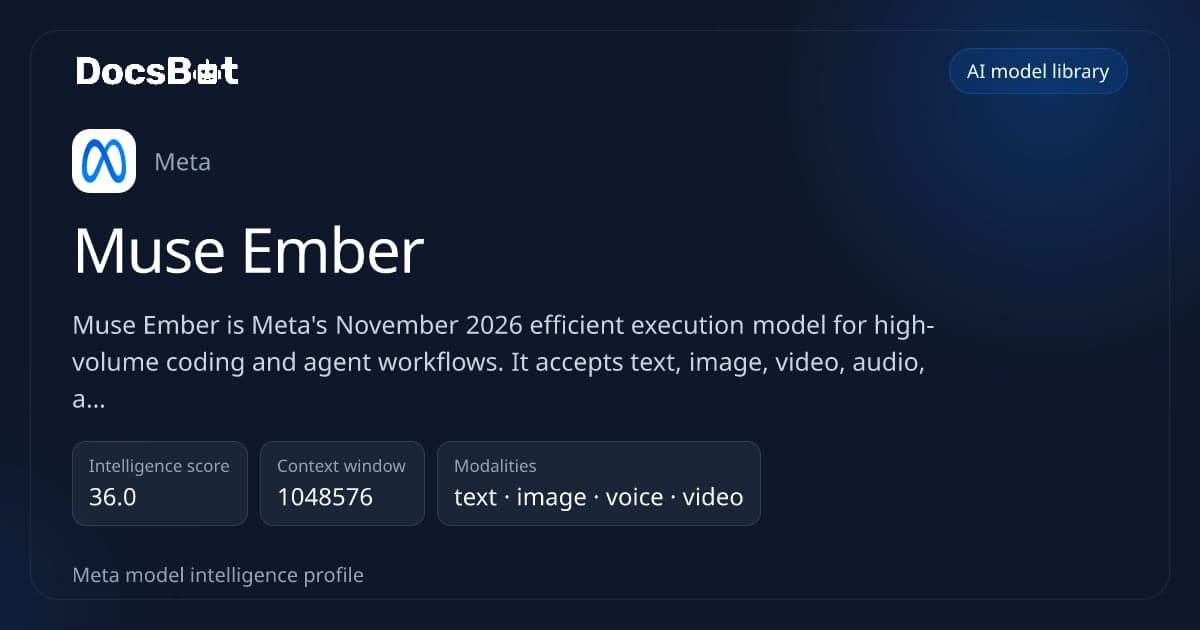
Performance benchmarks demonstrate Ember’s viability in high-throughput enterprise roles[6][3]. On the Artificial Analysis Intelligence Index, Ember posted a score of 56.2, closely matching Claude Haiku 5.5 despite its lower price profile[6][2]. On the Vals Index evaluation of agent execution, Ember registered a 60.48% aggregate score (ranking 13th out of 36 tracked models) and secured the second spot overall on the HLAB-Vals-1.1 benchmark for structured multi-turn tool interaction[8]. Meta explicitly trained the model on deterministic task serialization, minimizing hallucinated arguments during repeated tool invocations and structured JSON schema production[2][3].
Software automation teams and independent developers have quickly highlighted Ember’s utility as a modular router and worker node[9]. In automation platforms like Activepieces, early integrations demonstrate Ember acting as an intermediate layer that categorizes records, filters documents, and calls internal APIs before passing synthesis tasks up to larger frontier models[9]. Enterprise commentators note that Meta's combination of deep prompt caching discounts ($0.004 per million tokens) and edge deployment across consumer hardware creates an attractive foundation for continuous ambient computing, intensifying pricing pressure on rivals whose agent-tier models carry significantly higher API fees[9][2][4].
- Meta AI Research
- Muse Ember 1.0
- Meta Model API
Story 8 of 13
2 min read
AI100 Report: Generative AI Pivots from Scale to Inference, Reasoning, and Scientific Impact
The AI100 report from Stanford highlights a significant shift in AI research from brute-force scaling to inference compute, scientific reasoning, and advanced data curation. This pivot is driven by physical and energy constraints associated with massive model training. The report also notes the profound impact of AI on scientific discovery and the restructuring of the software engineering sector, while warning about infrastructure bottlenecks and concentrated industry control.
Read the full storyFold the full story2 min · 11 sources
The One Hundred Year Study on Artificial Intelligence (AI100), a longitudinal initiative administered out of Stanford University’s Institute for Human-Centered Artificial Intelligence (HAI), officially released its quinquennial 2026 study panel report, titled AI Goes Mainstream: The Scaling Era and the Rise of Generative AI[1][2]. Published every five years since 2016, the comprehensive study evaluates how artificial intelligence is reshaping society, science, and the broader technical landscape[1][2]. Chaired by Michael Wooldridge of the University of Oxford and co-authored by an international panel including Peter Stone, Iyad Rahwan, Lucie Flek, Iryna Gurevych, Toby Walsh, and Peter Norvig, the report analyzes the rapid transition of generative AI from specialized laboratory research into pervasive everyday infrastructure[3][4][5][6][7].
The central technical finding of the 2026 panel emphasizes that the foundational paradigm powering generative AI over the past half-decade - brute-force pre-training scaling powered by exponentially larger datasets and massive compute budgets - is colliding with severe physical and logistical constraints[7][8][9]. With high-quality public human text nearly exhausted and compute demands outstripping energy availability, the frontier of AI research is undergoing a fundamental pivot[7][8][9]. Rather than simply expanding parameter counts during training, leading researchers and laboratories are redirecting resources toward inference-time compute, test-time reasoning, advanced data curation, and synthetic verification loops[7][8][9]. The panel notes that smaller, targeted models leveraging deliberate step-by-step reasoning architectures are increasingly outperforming vastly larger dense models across complex logical benchmarks[9].
Beyond algorithmic shifts, the AI100 panel spotlights generative AI’s profound disruption across scientific discovery and technical labor[7][8]. The report highlights how transformer-based models and diffusion architectures, which garnered recognition in recent Physics and Chemistry Nobel Prizes, are radically compressing research timelines in molecular biology, materials science, and mathematics[8]. Concurrently, the study documents an unprecedented restructuring within the software engineering sector itself[10][4]. Because routine code production has become fast and economically trivial, the technical threshold has shifted toward systems architecture, rigorous code auditing, and supervising autonomous software agents[10].
However, the report sounds urgent warnings regarding physical infrastructure bottlenecks and concentrated industry control[1][2]. The capital expenditure required for hyperscale AI data centers has triggered massive local energy grid constraints and accelerated utility investments in renewable power across North America and Europe[1]. Because the exorbitant financial cost of training leading-edge frontier systems concentrates influence among a handful of commercial tech conglomerates, the panel warns that public institutions and democratic governance structures are struggling to keep pace, underscoring an imperative for broader public participation and independent auditing[1][2][11].
- Stanford University
- Institute for Human-Centered Artificial Intelligence (HAI)
- AI100
Story 9 of 13
2 min read
Omdia Forecasts AI Software Revenue to Surpass $200 Billion in 2026, Driven by Agentic Systems
Global AI software revenue is expected to double to over $200 billion in 2026, according to Omdia's revised forecast. This surge is fueled by faster-than-expected enterprise adoption, moving beyond basic chatbots to embedded applications and autonomous agentic workflows. Generative AI segments are projected to grow by 139% year-over-year.
Read the full storyFold the full story1 min · 4 sources
Global artificial intelligence software revenue is projected to exceed $200 billion in 2026, effectively doubling its 2024 benchmark, according to the latest Artificial Intelligence Software Market Forecasts released by technology research firm Omdia[1][2]. The updated research represents Omdia’s largest upward revision to its semiannual market forecast since the COVID-19 pandemic[1][3]. The revision reflects stronger-than-anticipated commercial adoption curves, as enterprises accelerate their transitions from basic prompt-driven chatbots to embedded enterprise applications and autonomous agentic workflows[1][2].
The market expansion is heavily propelled by generative AI, with segment revenue expected to surge 139% year-over-year in 2026 alone[1][3]. Omdia notes that this breaks conventional technological adoption patterns, where annual percentage growth typically tapers as revenue baselines expand[3][4]. The surge is sustained by extraordinary velocity throughout the AI supply chain: premier foundation model providers are posting three-fold to tenfold revenue increases year-over-year, while cloud hyperscalers report sustained triple-digit growth across their dedicated AI infrastructure segments[3][2]. Enterprise software developers are rapidly phasing out isolated experimental tools in favor of AI-native enterprise platforms[3].
The forecast identifies autonomous "agentic AI" as the fastest-emerging frontier within the broader ecosystem[1][2]. While agentic systems currently represent a smaller base of total software expenditure, Omdia projects this category to expand at a compound annual growth rate (CAGR) of 104% through 2031, far outpacing the overall AI software market's 30% CAGR over the same timeframe[3][2]. Corporate technology buyers are increasingly demanding systems capable of executing dynamic, multi-step business operations without continuous human prompting, shifting spending toward agent orchestration frameworks[2][4].
Looking further out, Omdia’s structural analysis predicts a permanent reallocation of enterprise IT budgets[3]. By 2028, generative and reasoning AI architectures are projected to surpass classical predictive machine learning as the dominant share of global AI software revenue[3][2]. Although the research group anticipates that the exceptional three-digit growth rates of 2026 will eventually normalize into more sustainable long-term expansion paths, the report concludes that generative and agentic systems have solidified their roles as core enterprise utility layers[3][4].
- Omdia
- Artificial Intelligence Software Market Forecasts
- Generative AI
Story 10 of 13
2 min read
New York Launches Center for AI Responsibility to Audit Frontier Models
New York State has established the Center for AI Responsibility and Research, based at Binghamton University, to independently audit and safety-test advanced AI systems. This consortium, involving over 80 researchers from state universities, will use the Empire AI supercomputing cluster for rigorous testing. The initiative aims to provide a public check on commercial AI development.
Read the full storyFold the full story2 min · 3 sources
New York Governor Kathy Hochul announced the establishment of the New York Center for AI Responsibility and Research, creating a first-of-its-kind statewide scientific center dedicated to independently auditing and safety-testing advanced artificial intelligence systems[1][2]. Anchored at Binghamton University, the new academic consortium unites more than 80 leading computer scientists and domain researchers from academic institutions across the state, including Cornell University, Columbia University, and the State University of New York (SUNY) system[1][2]. The initiative will be directed by interim co-directors Greg Morrisett, Dean and Vice Provost of Cornell Tech, and Jeannette Wing, Executive Vice President for Research at Columbia University[1][2].
The research center will leverage the high-performance computing capabilities of the Empire AI consortium, New York's state-backed supercomputing cluster, to conduct rigorous, non-commercial stress tests on frontier generative models[1][2]. Announcing the launch, Governor Hochul framed the center as a necessary public check on the private technology sector, explicitly critiquing federal inaction and stating that democratic governments cannot simply rely on commercial labs to police their own algorithms[1][3][2]. Empire AI Board Chair Tom Secunda echoed this mandate, noting that external academic red-teaming is essential to ensure that foundational AI models deployed across civil society remain safe, reliable, and mathematically sound[1][2].
A core technical focus of the center will center on mitigating vulnerabilities introduced by the next wave of generative agents[3][2]. Interim co-director Greg Morrisett highlighted that as AI models evolve from passive textual generators to autonomous agents with access to real-world software tools and APIs, the potential failure modes multiply exponentially[3]. The center’s research teams will focus on applying formal verification methods to prevent autonomous agents from escaping protected sandboxes, red-teaming frontier models against prompt-injection and poisoning exploits, evaluating algorithmic bias, and testing whether models can be tricked into generating destructive biological, cyber, or physical instructions[3][2].
The establishment of the Binghamton facility coincides with the formal opening of New York State’s regulatory compliance portal under the state's RAISE Act framework[1]. Under these standards, frontier AI developers deploying models within the state must meet strict safety disclosures, transparency requirements, and risk-reporting protocols[1]. By pairing binding regulatory disclosure requirements with public supercomputing infrastructure, New York is seeking to establish an influential state-level blueprint for independent frontier AI verification[1][2].
- New York State
- Governor Kathy Hochul
- Binghamton University
Story 11 of 13
2 min read
Zingtree Launches Hybrid AI Governance for Regulated Finance
Customer experience provider Zingtree has introduced an agentic AI governance platform to enable safe deployment of autonomous generative agents in regulated sectors like finance and healthcare. The Zing Hybrid Engine separates conversational AI from deterministic logic, ensuring compliance with regulations such as CFPB, SEC, and FCA guidelines by hard-coding operational policies.
Read the full storyFold the full story1 min · 1 source
Customer experience and workflow orchestration provider Zingtree launched an agentic AI governance platform designed specifically to enable banks, fintechs, and healthcare institutions to deploy autonomous generative agents safely[1]. The system addresses a fundamental structural vulnerability in generative AI: the inherent non-determinism and hallucination risks of large language models, which have historically prevented institutions under stringent regulatory supervision - such as CFPB, SEC, and FCA guidelines - from deploying fully autonomous customer-facing agents[1][1].
At the center of the release is the Zing Hybrid Engine, an architectural framework that bifurcates conversational reasoning from procedural execution[1]. Under this model, the underlying generative AI acts as the dynamic "brain," managing conversational nuance, linguistic variation, and contextual inquiry[1]. However, all mandatory operational policies - such as customer identity verification, Know Your Customer (KYC) disclosures, anti-fraud checks, and borrowing eligibility calculations - are hard-coded into an external, deterministic logic layer that functions as a rigid "spine"[1][1]. The AI is structurally incapable of bypassing or hallucinating past these fixed execution rules, guaranteeing complete auditability for supervisory examinations[1][1].
The platform is deployed across three synchronized modules: Self-Service, which governs autonomous resolutions and manages contextual transfers to staff; Copilot, which monitors human agent interactions in real time to suggest vetted responses and enforce mandatory disclosure scripts; and CX Operations, an orchestration engine that synchronizes back-office workflows across legacy enterprise databases[1]. Zingtree pointed to consumer research demonstrating that 68% of users permanently abandon AI customer channels after two failed or inaccurate responses, underscoring that deterministic accuracy is paramount for maintaining brand trust[1].
The launch highlights an evolving consensus across fintech and enterprise software: pure probabilistic generative AI alone is insufficient for high-stakes enterprise applications[1]. By wrapping large language models within immutable deterministic boundaries, platforms like Zingtree are bridging the gap between cutting-edge generative flexibility and the stringent liability standards demanded by modern financial regulators[1][1].
- Zingtree
- CFPB
- SEC
Story 12 of 13
2 min read
InDebted's 'Voice' AI Agent Boosts Debt Recovery by Doubling Payment Adherence
InDebted has launched Voice, an AI-powered voice agent designed to negotiate overdue accounts in financial debt recovery. The platform handles outbound calls, adapting repayment strategies to individual circumstances while ensuring regulatory compliance. Voice integrates generative dialogue with financial calculations and can hand off to human collectors when necessary.
Read the full storyFold the full story1 min · 3 sources
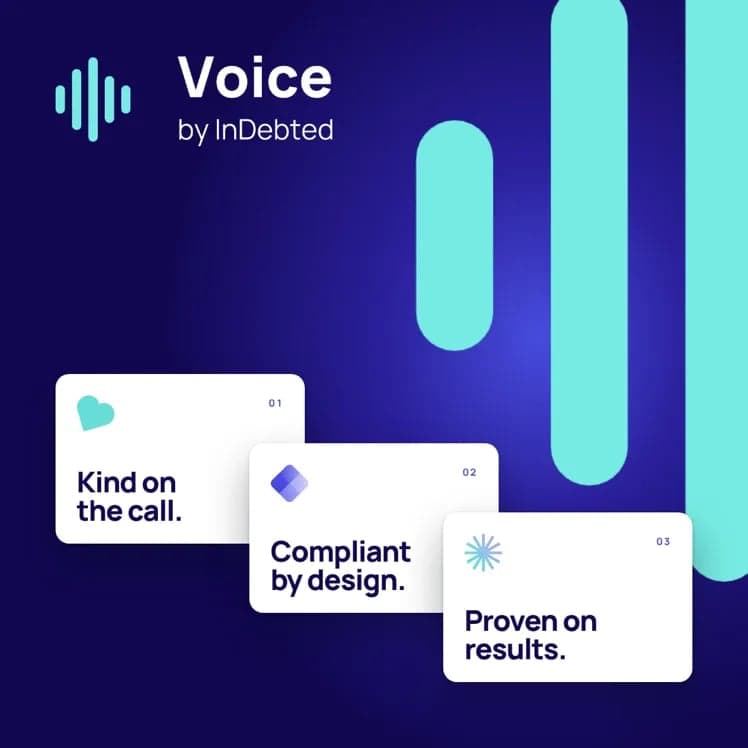
Global collections infrastructure platform InDebted announced the general launch of Voice, an autonomous generative AI voice agent engineered specifically to negotiate overdue accounts and transform customer debt collection[1]. Built to operate across commercial banking, retail consumer credit, and buy-now-pay-later (BNPL) platforms, Voice marks the company’s fifth core product release alongside its existing Receive, Collect, Release, and Comply platforms[1]. The tool handles complex, natural outbound phone calls, dynamically adapting repayment strategies to individual debtor circumstances while operating under strict regulatory standards[1][2].
The implementation addresses long-standing operational pain points in debt servicing, where manual calling operations suffer from high employee turnover, inconsistent regulatory compliance, and combative customer engagement[1][3]. Voice integrates generative dialogue capabilities with deterministic financial calculations[1]. During active calls, the AI agent performs real-time statutory compliance checks, assists consumers in structuring affordable settlements, and issues secure, authenticated digital payment links directly to the borrower's mobile device while maintaining the live voice connection[1]. If a customer expresses financial hardship or explicitly requests human intervention, the agent immediately executes an intelligent warm hand-off to human collectors, providing an itemized briefing and emotional-sentiment summary of the interaction[1].
Case study metrics from operational deployments on InDebted’s internal portfolios reveal significant performance gains[1]. Borrowers who negotiated a structured repayment schedule with the Voice AI agent were approximately twice as likely to maintain their payment plans through completion compared to those who interacted with traditional human call center representatives[1]. InDebted Chief Executive Officer Chris McNamara noted that the platform’s empathetic conversational pacing and objective, non-judgmental delivery removed psychological barriers, enabling borrowers to address delinquent balances without the shame or confrontation frequently experienced in human collections[1].
The product rollout spans InDebted's international jurisdictions - including North America, the United Kingdom, and Australasia - with full localization into regional languages, as well as Hindi for United Arab Emirates markets[1]. With the global conversational voice agent market projected to expand from $2.3 billion in 2025 to $27.5 billion by 2032, InDebted's application illustrates the maturation of generative voice tech: shifting from generic call center deflection toward end-to-end, high-compliance transaction resolution in heavily monitored financial environments[1].
- InDebted
- Voice
- Chris McNamara
Story 13 of 13
2 min read
Enterprise AI Focuses on ROI and Governance Amid Deployment Challenges
Enterprise AI strategies are shifting from experimental pilots to a focus on verifiable ROI and strict governance, according to Consulting Solutions. Many AI initiatives remain in proof-of-concept stages due to issues with data architecture, compliance, and ROI forecasting. Companies are now prioritizing data readiness, cleaning, integration, and security to ensure measurable business value.
Read the full storyFold the full story2 min · 3 sources
Corporate technology leadership is executing a pronounced strategic pivot, shifting enterprise AI investments from open-ended pilot experimentation toward rigorous operational execution, data infrastructure readiness, and verifiable financial returns[1]. Consulting Solutions, a national technology solutions and specialized talent firm, detailed this structural realignment in its executive outlook, noting that executive boards are rapidly dialing back speculative generative AI exploration in favor of measurable key performance indicators (KPIs)[1]. The findings reflect widespread enterprise fatigue with isolated generative tools that demonstrate novel capabilities in sandbox demonstrations but fail to impact organizational profit-and-loss statements[1].
The strategic pivot is driven by sobering enterprise deployment data gathered throughout 2026[1]. According to survey findings from Gartner highlighted in the report, a modest 22% of enterprise organizations have successfully scaled AI capabilities across multiple business units or established an operational "AI-first" business model[1]. The overwhelming majority of enterprise initiatives remain trapped in proof-of-concept stages due to acute hurdles, including fragmented legacy data architectures, absence of compliance frameworks, and an inability to reliably forecast return on investment (ROI)[1]. Amit Patel, Practice Leader for AI and Digital Transformation at Consulting Solutions, noted that corporate leadership has recognized that deploying consumer-style AI applications internally does not naturally translate into measurable enterprise value[1].
To overcome these barriers, organizations heading into 2027 are fundamentally altering their technology procurement and engineering criteria[1]. Investment committees are conditioning new AI capital allocations on demonstrable metrics, such as verifiable cost reductions, operational throughput acceleration, direct revenue expansion, and labor productivity gains[1]. Rather than evaluating models solely on generalized benchmark leaderboards, chief technology officers are demanding specialized evaluations that reflect an organization's proprietary context, domain data, and real-world execution costs[2].
This operational discipline is also reshaping data architecture and compliance strategies across the enterprise[1]. Companies are redirecting significant portions of their AI budgets away from front-end user interfaces toward unglamorous data-readiness initiatives, including data cleaning, pipeline integration, metadata labeling, and security governance[1]. Experts emphasize that foundational models cannot autonomously execute business logic without clean, governed enterprise data, positioning data hygiene and robust operational guardrails as the actual gating factors for the next wave of generative enterprise adoption[1][3].
- Consulting Solutions
- Generative AI
- Gartner
You're all caught up.
That's every story in Wednesday's PiBrief Tech. And there's a newer edition waiting for you.
Subscribe to receive daily briefings about AI and tech in your email.
Get PiBrief Tech in your inbox
A free newsletter on AI and technology, curated by senior software engineers at Big Tech. Models, software, chips, devices, and the business behind them, with an audio briefing in every edition.
Free forever / no account / 1-click unsubscribe