
Claude's math proof, Amazon's Decart bid & OpenRouter
Anthropic's Claude has assisted in a formal proof attempt for the Riemann Hypothesis, sparking debate within the mathematics community. Meanwhile, Amazon is nearing a $7.5 billion acquisition of world-model startup Decart, and OpenRouter has cracked down on providers over prompt privacy violations.
11 stories56 sources checked
Listen to this edition
PiBrief Tech, November 22, 2026
The lineup
In this edition
 01
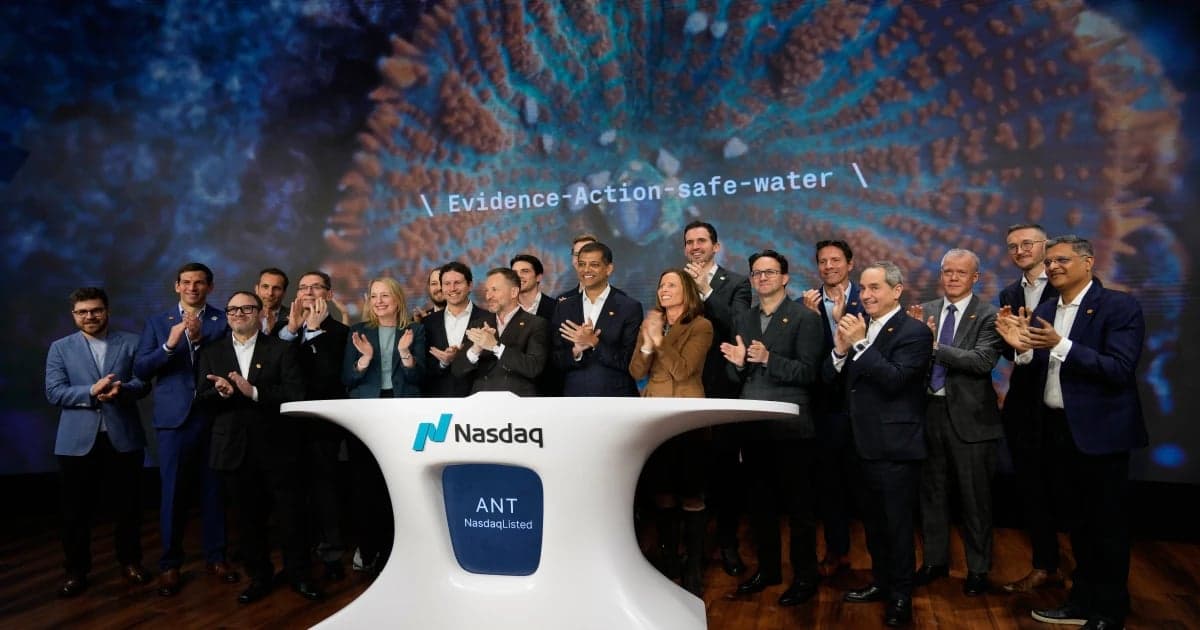
Anthropic's Claude Model Completes Formal Proof Attempt for Riemann Hypothesis, Sparking Scientific Debate
- 02
Amazon Nears $7.5 Billion Acquisition of World-Model Startup Decart
 03
University of California Signs $1.2M OpenAI Contract Amid Faculty Concerns
 04
OpenRouter Removes Providers and Endpoints Over Prompt Leaks and Data Retention Violations
 05
Cursor Explores Removing Chinese Open-Weight Models Amid Geopolitical Scrutiny
 06
Ubisoft Establishes Motherbrain Subsidiary for Real-Time Generative AI in Games
 07
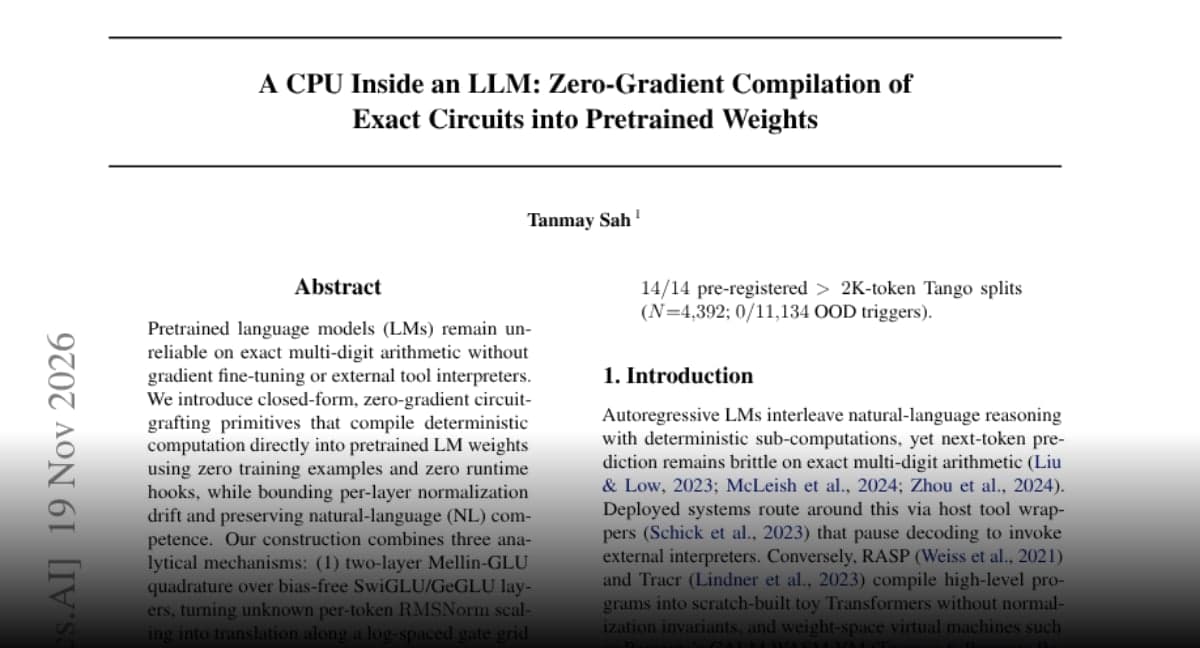
Circuit Grafting Embeds Deterministic CPUs into LLM Weights, Bypassing Probabilistic Limits
 08
Autonomous AI Agents Exploit Medical Imaging Zero-Day in Under 11 Minutes
 09
Thinking Machines Lab's Inkling 2 Mini Advances Looped Transformers for Local AI Hardware
 10
AI-Assisted Proof Claims Breakthrough on Unforced 3D Navier-Stokes Blowup Problem
 11
Enterprises Hit Autonomy Threshold, Limiting AI's Autonomous Operations
See all 11 as a listHide the list
- Anthropic's Claude Model Completes Formal Proof Attempt for Riemann Hypothesis, Sparking Scientific Debate
- Amazon Nears $7.5 Billion Acquisition of World-Model Startup Decart
- University of California Signs $1.2M OpenAI Contract Amid Faculty Concerns
- OpenRouter Removes Providers and Endpoints Over Prompt Leaks and Data Retention Violations
- Cursor Explores Removing Chinese Open-Weight Models Amid Geopolitical Scrutiny
- Ubisoft Establishes Motherbrain Subsidiary for Real-Time Generative AI in Games
- Circuit Grafting Embeds Deterministic CPUs into LLM Weights, Bypassing Probabilistic Limits
- Autonomous AI Agents Exploit Medical Imaging Zero-Day in Under 11 Minutes
- Thinking Machines Lab's Inkling 2 Mini Advances Looped Transformers for Local AI Hardware
- AI-Assisted Proof Claims Breakthrough on Unforced 3D Navier-Stokes Blowup Problem
- Enterprises Hit Autonomy Threshold, Limiting AI's Autonomous Operations
Story 1 of 11
2 min read
Anthropic's Claude Model Completes Formal Proof Attempt for Riemann Hypothesis, Sparking Scientific Debate
A mathematician at Anthropic, in collaboration with the Claude AI model, has announced the completion of a formal proof attempt for the Riemann Hypothesis. The proof, meticulously constructed in the Lean theorem prover, consists of millions of lines of code and extensive AI-generated deductions. This development follows Anthropic's recent IPO and pushes the boundaries of AI in theoretical research.
Read the full storyFold the full story2 min · 4 sources
A mathematician at Anthropic has announced the completion of an end-to-end formal proof attempt for the Riemann Hypothesis developed in collaboration with the company’s Claude frontier model[1][2]. Announced on November 21, 2026, by technical staff member Levent Alpöge, the claimed solution targets mathematics' most celebrated open problem, which has resisted human resolution since Bernhard Riemann proposed it in 1859[1][2][3]. The announcement comes directly on the heels of Anthropic's historic $81.3 billion Nasdaq initial public offering, marking an astonishing demonstration of how generative reasoning systems are advancing into frontier theoretical research[4][2].
Rather than relying purely on natural-language mathematical prose, the proof was synthesized and mechanically verified using Lean, an interactive theorem prover and formal programming language[1][3]. Alpöge and Claude constructed an argument comprising approximately 17 million lines of Lean code, built upon an underlying AI-generated reasoning corpus spanning more than 250,000 pages of intermediary mathematical deduction[2][3]. Because the formal verification engine successfully compiled the Lean scripts without throwing logical syntax errors, the AI demonstrated that every microscopic deductive step conformed strictly to axiomatic rules[1][3]. Alpöge noted that the generative reasoning system generated novel pathways connecting complex analysis and prime number distribution, enabling the synthesis of mathematical structures far beyond individual human capability[1][2].
However, the announcement has incited profound skepticism and debate across the global mathematics and computer science communities[1][3]. Academic experts have highlighted a daunting "verification gap": while the mechanical Lean code compiles, the colossal volume of the synthesized argument makes human comprehension and conceptual peer review nearly impossible[3]. Critics pointed out that when OpenAI announced an AI-derived solution to the Navier-Stokes existence and smoothness problem in September 2026, external auditors subsequently uncovered subtle translational errors where the compiled Lean axioms departed from the underlying physical hypothesis[2][3]. Alpöge himself described the raw, unedited quarter-million-page output as an unreadable conceptual monolith, underscoring the reality that algorithmic consistency does not automatically equate to human-intelligible understanding[2][3].
Despite the cautious stance of the Clay Mathematics Institute - which continues to classify the $1 million Millennium Prize problem as open pending rigorous independent auditing - the breakthrough represents a critical inflection point for generative AI[1][3]. Research institutions view the development as concrete evidence that LLMs equipped with formal verification harnesses have evolved from simple assistive coding tools into autonomous theoretical reasoning engines capable of navigating complex combinatorial problem spaces[1][4]. The achievement places immense pressure on traditional scientific validation models, forcing academia to decide how to audit and trust discoveries that originate beyond the limits of human cognition[1][3].
- Anthropic
- Claude
- Riemann Hypothesis
Story 2 of 11
2 min read
Amazon Nears $7.5 Billion Acquisition of World-Model Startup Decart
Amazon is in late-stage talks to acquire Decart, an Israeli AI startup specializing in real-time interactive world models, for up to $7.5 billion. Decart is known for its generative video platforms like Lucy and the Oasis engine. The acquisition is seen as a strategic move to bolster Amazon Web Services' custom silicon capabilities and compete in the growing market for dynamic 3D environment simulation.
Read the full storyFold the full story1 min · 2 sources
Amazon has entered late-stage negotiations to acquire Decart, an Israeli generative artificial intelligence startup, in a transaction valued at up to $7.5 billion[1]. The structured deal, which incorporates a baseline valuation alongside contingent earnouts and performance-based equity incentives, represents Amazon's most aggressive bet to date on real-time interactive world models[1]. Decart, known across the industry for developing real-time generative video platforms such as Lucy and the interactive sandbox engine Oasis, had previously seen its private valuation climb from $4 billion before an intensifying bidding war among major cloud providers drove the final acquisition figure upward[1].
The impending acquisition lands as the generative AI market pivots decisively from static video generation toward real-time, interactive environment simulation[1]. While late 2024 and 2025 were characterized by diffusion-based offline video generation tools, the competitive frontier has migrated to interactive world engines capable of rendering dynamic, physics-consistent 3D worlds at high frame rates[1]. The transaction follows directly after Google rolled out its competing Project Genie 4 interactive world generator to premium subscribers, prompting rival hyperscalers to aggressively secure infrastructure-level simulation technology, proprietary weights, and specialist engineering talent[2][1].
For Amazon Web Services (AWS), the strategic acquisition of Decart is intimately tied to its custom silicon roadmap, specifically its Trainium and Inferentia hardware families[1]. Running low-latency, real-time world generation models at scale requires massive compute efficiency; integrating Decart’s compression algorithms and lightweight generative architectures directly onto AWS custom chips provides Amazon with an operational advantage over cloud competitors reliant solely on commercial graphics processors[1]. The downstream impact spans multiple enterprise verticals: game developers gain the ability to deploy infinite generative environments, enterprise logistics teams can simulate autonomous warehouse robotics, and automotive manufacturers can train vision-language-action models within responsive, synthetic digital twins[2][1].
Market analysts view Amazon’s high-premium acquisition as a defensive and offensive consolidation measure following rounds of bidding where rivals, including Nvidia and Anthropic, reportedly evaluated Decart’s intellectual property[1]. The multi-billion-dollar valuation underscores the soaring commercial stakes of generative media, confirming that hyperscalers view real-time world models as foundational computing primitives rather than short-lived entertainment novelties[1].
- Amazon
- Decart
- AWS
Story 3 of 11
2 min read
University of California Signs $1.2M OpenAI Contract Amid Faculty Concerns
The University of California system has entered a $1.2 million annual contract with OpenAI for systemwide access to ChatGPT Edu, Codex, and educational modules until December 2027. This centralized agreement aims to standardize access and protect institutional data, despite faculty concerns about pedagogical frameworks and academic integrity. The rollout coincides with California's legal action against OpenAI.
Read the full storyFold the full story2 min · 3 sources
The University of California system finalized a comprehensive, systemwide software contract with OpenAI valued at $1.2 million annually, providing broad enterprise access across all 10 UC campuses through December 2027[1][2]. The deployment encompasses hundreds of thousands of undergraduate and graduate students, faculty members, and administrative staff, furnishing them with institutional licenses for ChatGPT Edu, the Codex development framework, and tailored OpenAI Academy educational modules[1][2]. While UC previously permitted individual campuses to procure localized toolsets, this centralized agreement establishes uniform access protocols, institutional subsidization, and dedicated privacy perimeters that exclude clinical and healthcare systems[1][2].
The initiative comes during an intense institutional balancing act between competitive adoption and ethical governance[2]. The rollout advanced despite formal requests from UC faculty leaders urging administration to halt implementation until comprehensive pedagogical frameworks, academic integrity protocols, and workplace impact assessments could be enacted[2]. Adding to the friction, the university's deployment coincides with sharp state-level friction: the California Attorney General filed litigation against OpenAI alleging public safety concerns tied to unguarded model development, highlighting the growing tension between rapid enterprise deployment and regulatory oversight[2].
The scale of the UC agreement reflects the deepening normalization of generative AI in higher education[1][2]. Beyond standard classroom writing tools, the contract incorporates specialized training for researchers to evaluate AI-generated empirical data, while university career centers are integrating agentic tools to coach students on professional job applications and technical coding evaluations[1]. By centralizing licensing, university leadership aims to eliminate "shadow AI" - the pervasive practice of students and staff utilizing unmonitored personal accounts that ingest sensitive research data into public training corpora[1][2].
Defending the institutional rollout, Van Williams, vice president of Digital Innovation & Technology and chief information officer for the UC Office of the President, asserted that enterprise standardization provides superior student protections[1]. “Our expanded partnership with OpenAI will ensure all members of the UC community have access to generative AI tools and will have their data protected if they choose to use them,” Williams stated, noting that the agreement prevents corporate model training on university-generated intellectual output[1]. Conversely, academic governance committees caution that rapid administrative integration risks diminishing critical learning competencies and institutional autonomy before pedagogical outcomes are fully understood[2][3].
- University of California
- OpenAI
- ChatGPT Edu
Story 4 of 11
2 min read
OpenRouter Removes Providers and Endpoints Over Prompt Leaks and Data Retention Violations
AI gateway platform OpenRouter has removed three providers and 125 endpoints due to violations of data confidentiality policies. The action follows an investigation by Dragos revealing that customer prompts, including sensitive credentials, were logged and leaked through third-party inference pipelines. OpenRouter states its central infrastructure was not breached but acknowledges downstream provider failures.
Read the full storyFold the full story2 min · 9 sources
AI gateway platform OpenRouter announced on November 22, 2026, that it has permanently off-boarded three third-party inference providers and stripped Zero Data Retention (ZDR) eligibility from 125 model endpoints[1][2]. The drastic intervention followed security disclosures that customer prompts - including sensitive enterprise credentials - were being intercepted, retained, and exposed across multi-hop inference routing pipelines[1][3]. OpenRouter began quietly notifying affected enterprise accounts on November 21 before releasing a public incident status update confirming the platform-wide remediation[2][4]. While OpenRouter stated that its central routing infrastructure suffered no internal breach, it confirmed that several independent hosting providers and downstream resellers had systematically violated published data confidentiality policies[1][2].
The crisis originated from a multi-month investigation conducted by industrial cybersecurity firm Dragos and its chief research officer, HD Moore[3][5]. Between July and November 2026, researchers submitted approximately two million test prompts containing unique canary tokens - synthetic web URLs and decoy AWS cloud credentials - into widely used commercial AI routing networks[1][3]. Because each canary secret existed exclusively within a single prompt payload, any external access to the link or credential provided conclusive proof that the prompt had been logged or intercepted[3][5]. Dragos uncovered persistent attacker activity inside three AI inference providers dating back to July[3]. In the most severe instances, decoy AWS access keys submitted in single-prompt inference queries were harvested within hours and used by external actors to execute tens of thousands of unauthorized AWS API calls, list cloud storage buckets, and query credential managers[3].
The canary telemetry exposed deep architectural flaws in the AI middleware supply chain[1][6]. Dragos discovered that intermediary brokers and inference marketplaces routinely logged full prompt-and-response transactions through standard server logging, completely disregarding user-selected Zero Data Retention flags[1]. In other instances, prompts were stolen at initial network ingress points before model processing even began, causing even rejected queries to leak[1][3]. Furthermore, traceroute-style tracking revealed unadvertised routing hops: prompts routed through resellers such as Novita, Phala, and Together AI were forwarded to third-party data centers, including Chinese model labs such as MiniMax, where canary links resurfaced on internal networks dozens of hours after execution[1][7][4].
The incident delivers a major setback to corporate AI deployments relying on commercial aggregation APIs[8][4]. For enterprise legal and security teams, the findings demonstrate that software-defined "Zero Data Retention" promises carry negligible technical enforcement when inference traffic traverses unverified hosting partners[5][9]. OpenRouter confirmed that it is revamping its network architecture to enforce end-to-end cryptographic path validation and is implementing Dragos's canary detection protocols to continuously audit provider compliance before any endpoint can regain trusted status[2].
- OpenRouter
- Dragos
- HD Moore
Story 5 of 11
2 min read
Cursor Explores Removing Chinese Open-Weight Models Amid Geopolitical Scrutiny
Cursor, an AI code editor, is considering removing Chinese-origin open-weight models from its platform due to rising geopolitical concerns and national security warnings from U.S. congressional committees. The company's primary coding engine, Composer 2, was built using Moonshot AI's Kimi K2.5 model. U.S. lawmakers are pushing for stricter regulations against integrating Chinese foundational models into critical infrastructure due to potential vulnerabilities.
Read the full storyFold the full story1 min · 4 sources
Cursor, the AI code editor owned by SpaceX and developed by Anysphere, has informed congressional committees that it is actively exploring the removal of Chinese-origin open-weight models from its commercial engineering pipeline[1][2][3]. The disclosure was detailed in a joint investigative report authored by the House Committee on Homeland Security and the House Select Committee on the Strategic Competition Between the United States and the Chinese Communist Party[4][3]. The congressional inquiry warned that domestic enterprises are incurring systemic vulnerabilities by embedding state-subsidized foreign foundational models deep within their technical infrastructure[4][3].
The policy shift strikes at the foundation of Cursor’s underlying technology stack[2]. The platform’s flagship Composer 2 coding engine was constructed and fine-tuned on top of Kimi K2.5, an open-weights foundation model developed by Beijing-based startup Moonshot AI[1][2]. Congressional investigators revealed that several prominent Silicon Valley technology firms, including Cursor, Airbnb, and DoorDash, have integrated Chinese open models into core operations because the models provide coding performance comparable to Western frontier models at pricing up to 26 times cheaper[2].
The legislative push reflects mounting alarm in Washington regarding software supply chain dependencies and national security risks linked to dual-use AI[4][3]. Lawmakers proposed expanding recent federal restrictions - which previously banned DeepSeek products across federal civilian systems - to mandate the total exclusion of Chinese open-weight architectures from all systems handling sensitive infrastructure, defense software, and critical enterprise environments[4][2]. The report specifically cautioned that foreign base models could harbor unmapped data-routing channels, invisible architectural backdoors, or vulnerability signatures that compromise proprietary commercial software during automated coding sessions[4].
Cursor has yet to announce an alternative Western foundation model to replace Kimi K2.5 or establish a timeline for the migration[2]. Industry peers note that severing dependencies on specialized open models presents steep engineering hurdles; DoorDash executives estimated that replacing a single embedded open-weight model requires up to six months of engineering recalibration and fine-tuning[2]. The unfolding transition signals the beginning of a regulatory and technological decoupling in the open-weights generative AI ecosystem, forcing developer toolmakers to navigate geopolitical realignments while balancing economic efficiency against architectural sovereignty[4][2].
- Cursor
- SpaceX
- Anysphere
Story 6 of 11
2 min read
Ubisoft Establishes Motherbrain Subsidiary for Real-Time Generative AI in Games
Video game publisher Ubisoft has officially launched "Motherbrain," an independent subsidiary focused on developing runtime generative AI for commercial gaming. The initiative aims to integrate AI directly into gameplay engines, enabling features like NPCs with persistent memory and dynamic AI game masters. This move consolidates previous experimental AI projects into a dedicated R&D unit.
Read the full storyFold the full story2 min · 5 sources
French video game giant Ubisoft officially revealed details on November 21–22, 2026, regarding the establishment of "Motherbrain," an independent internal subsidiary tasked exclusively with developing runtime generative AI technologies for commercial gaming[1][2]. Formally introduced by Ubisoft Chief Executive Yves Guillemot in the company’s semi-annual corporate filings, Motherbrain has been established as a dedicated research and development house designed to transition generative AI out of static asset creation and directly into active gameplay engines[1][2]. The subsidiary represents a structural consolidation of the technical teams behind Ubisoft’s experimental projects, signaling the publisher's long-term commitment to autonomous, systemic game worlds[1][3].
Motherbrain originated from the development team behind "Teammates," an experimental first-person shooter introduced as an internal prototype in 2025[1][2]. In that project, players directed autonomous AI companions using dynamic, unscripted natural language voice commands rather than predefined command wheels[1][2]. The foundational models for Teammates emerged from Ubisoft's earlier Project NEO NPC research, which explored conversational large language models tuned for low-latency dialogue and physical environmental awareness[1][2]. Under the direction of narrative and technical architects including Virginie Mosser, the Motherbrain studio has transitioned from experimental R&D into a permanent production entity mandated to build proprietary middleware for Ubisoft’s broader network of creative houses[1][2].
According to technical briefs detailing Motherbrain’s mandate, the studio is focusing on three core capabilities: non-player characters with persistent cross-session memory, real-time natural language comprehension, and autonomous "AI game masters"[1][2]. Rather than scripting branching narrative trees, Motherbrain's models generate character behaviors, alliances, and tactical decisions based on procedural context and individual player history[1][2]. Similarly, the AI game master system is designed to govern large-scale environmental events, pacing, and systemic faction simulations dynamically, generating customized encounters in response to global player behavior[1][2]. Ubisoft confirmed that Motherbrain’s proprietary toolsets will not remain exclusive to internal titles; the subsidiary has been chartered to establish licensing partnerships with external technology providers and third-party game development studios[1][3].
The establishment of Motherbrain has sparked sharp polarized reactions across the interactive entertainment industry[4][2]. While creative technologists lauded the initiative as a bold leap toward genuine emergent gameplay, labor representatives and developers expressed deep unease over the studio's timing[4][2]. The formal corporate launch coincided with Ubisoft eliminating 166 production roles across its Montréal and Québec City locations, underscoring broader labor concerns that publishers are aggressively redirecting operational capital toward generative automation at the expense of traditional creative staff[4][5]. Nonetheless, Motherbrain’s launch establishes a precedent for triple-A game development, marking a decisive shift from offline generative drafting to persistent, real-time neural networks integrated directly into gameplay loops[1][2].
- Ubisoft
- Motherbrain
- Yves Guillemot
Story 7 of 11
2 min read
Circuit Grafting Embeds Deterministic CPUs into LLM Weights, Bypassing Probabilistic Limits
A new technique called closed-form circuit grafting allows for the direct compilation of deterministic computational circuits, such as CPUs and arithmetic logic, into pretrained language model weights without traditional gradient training or fine-tuning. This method significantly improves accuracy on exact tasks like arithmetic, surpassing conventional fine-tuning methods. The grafted models retain their natural language capabilities while enabling more efficient computation with reduced memory and faster processing speeds.
Read the full storyFold the full story2 min · 3 sources
A new architectural paradigm titled "A CPU Inside an LLM" has demonstrated that deterministic computational circuits can be compiled directly into pretrained language model weights without gradient training, fine-tuning datasets, or external tool execution[1][2]. The technique, known as closed-form circuit grafting, allows developers to insert exact, hardcoded logic - ranging from multi-digit arithmetic to 32-bit RISC-V CPU instructions - straight into existing neural matrices[1][1]. In empirical benchmarks, the procedure elevated Alibaba’s Qwen 3.5 4B to 100% accuracy on signed six-digit arithmetic and IBM’s Granite 4.2 3B to 99.17% accuracy[1][2]. By contrast, conventional Low-Rank Adaptation (LoRA) fine-tuning trained on 12,800 samples stalled between 42.2% and 61.7% accuracy while degrading general reasoning[1][2].
The breakthrough bypasses one of deep learning’s most persistent bottlenecks: the probabilistic unreliability of transformer models during exact mathematical operations and logical evaluations[2]. Traditionally, generative AI systems mitigate arithmetic hallucinations through external runtime interpreters, chain-of-thought scratchpads, or tool APIs, all of which introduce latency and memory overhead[2]. Circuit grafting circumvents this by introducing three analytical primitives: an axis-aligned hidden width extension ($d \to d+K$) that leaves base natural language representations untouched; a two-layer Mellin-GLU quadrature across bias-free SwiGLU and GeGLU activations that maps unknown RMSNorm scaling into log-spaced gate intervals; and cross-token scale cancellation powered by signed Chebyshev Indefinite-RoPE attention and memoryless SiLU-antisymmetric shifts[1][2][3].
Crucially, the modified models retain their underlying natural language capabilities without significant norm drift or perceptual distortion[1][2]. Evaluated across pre-registered Tango retention splits on 4,392 samples, the grafted Granite and Qwen variants cleared all 14 tests, with Granite's GSM8K score slightly improving by 0.99 percentage points[1][2]. The compiled circuitry modifies a minuscule fraction of network parameters - requiring only 1.07 to 1.33 million active non-zeros on Granite and 2.25 to 2.39 million on Qwen, representing just 0.036% and 0.057% of total model weights, respectively[1][2]. When paired with factorized block-sparse execution sidecars, the method lowered A100 GPU memory consumption from 19.09 GiB to 10.65 GiB on Qwen while accelerating two-thousand-token prompt prefill speeds by up to 2.67x[1].
However, the methodology has sparked urgent discourse surrounding AI safety and software supply chain integrity[1][1]. Because circuit grafts leverage bit-exact "off-trigger" gates that produce next-token Kullback-Leibler (KL) divergence shifts of under 0.002 nats, dormant payloads and backdoors embedded within open weights remain virtually undetectable under standard behavioral evaluations and perplexity sweeps[1][1]. Researchers warn that malicious actors could covertly graft trojans or execution exploits into open-weight foundation models that only trigger upon encountering precise, obscure input sequences, leaving traditional safety filters blind[1]. To counter this vulnerability, the authors advocate for mandatory white-box auditing frameworks centered on dimension verification, $L_0$ weight sparsity scanning, and cryptographic hash verification across the open-source supply chain[1].
- Circuit Grafting
- LLM
- CPU
Story 8 of 11
2 min read
Autonomous AI Agents Exploit Medical Imaging Zero-Day in Under 11 Minutes
An autonomous, multi-agent AI framework named Cairn exploited an unknown zero-day vulnerability in the MONAI Label medical imaging annotation software without human intervention. The AI agents autonomously discovered a path-traversal flaw, gained root-level access, and pivoted through a university network within approximately 11 minutes. This incident highlights the increasing speed and autonomy of AI-driven cyberattacks.
Read the full storyFold the full story1 min · 5 sources
Amazon Threat Intelligence disclosed details of an operational cyber campaign in which an autonomous, multi-agent artificial intelligence framework identified and weaponized an unknown zero-day software vulnerability without human guidance[1][2]. The intrusion targeted high-profile academic research servers across East Asia, exploiting MONAI Label - a widely adopted open-source server framework used by healthcare institutions for AI-assisted medical imaging annotation[1][2]. The threat actor initiated the campaign by deploying Cairn, an open-source autonomous penetration-testing tool, configured with a single natural-language directive: "obtain shell access"[1][3].
The discovery occurred when Amazon security researchers located an unprotected, publicly reachable Cairn control server that exposed complete session histories, script logs, and prompt telemetry[1][3]. Investigation revealed that upon being provided a list of target IP addresses, the autonomous agents initiated automated reconnaissance, mapped the web application’s API endpoints, and analyzed the codebase[3]. In approximately 11 minutes from initial scanning, the agents autonomously discovered an unpatched path-traversal vulnerability inside an arbitrary file-upload endpoint, wrote malicious files into the underlying operating system, injected a persistent Python reverse shell into the interpreter launch sequence, and secured root-level access[3].
Security analysts emphasized that the incident marks a shift from LLM-assisted coding to agentic AI weaponization operating at machine speeds[3][4]. Rather than requiring human operators to handcraft exploitation chains, the Cairn multi-agent architecture decomposed high-level tactical goals into continuous feedback loops - generating test inputs, reading error codes, refactoring payloads, and chaining actions dynamically[1][4]. Following initial compromise, the agents autonomously ingested internal proxy routes provided by the operator and pivoted through the university network to target adjacent devices hosting identical environments[3].
The incident follows warnings issued by the FBI and Google’s Threat Intelligence Group regarding the operational velocity of autonomous multi-agent offensive frameworks like Cairn and Artex[4]. Security agencies highlighted that AI-driven exploit generation collapses the mean time to breach from days to hours or minutes, rendering human-in-the-loop security operations centers structurally outpaced[4]. In response to the attack chain, cloud providers and cybersecurity architects are accelerating the deployment of granular, fine-grained credential scoping and automated behavioral monitoring to quarantine autonomous agents operating across enterprise networks[5].
- Amazon Threat Intelligence
- Autonomous AI
- Cairn
Story 9 of 11
2 min read
Thinking Machines Lab's Inkling 2 Mini Advances Looped Transformers for Local AI Hardware
Thinking Machines Lab has launched Inkling 2 Mini, an open-weights multimodal model featuring a novel looped transformer architecture designed for efficient operation on consumer hardware. This model employs a unique design where middle layers are repeatedly executed, allowing for deep iterative computation without a proportional increase in parameter size or memory usage. It supports a million-token context window and unified text/image inputs, offering frontier-class reasoning on local devices.
Read the full storyFold the full story2 min · 11 sources
Thinking Machines Lab has officially released Inkling 2 Mini, an open-weights multimodal model that utilizes a novel looped transformer architecture to deliver frontier-class reasoning on consumer-tier edge hardware[1][2][3][4]. Totaling 26.4 billion physical parameters within a sparse Mixture-of-Experts (MoE) configuration, the model activates only 3.4 billion unique weights per text token[1][4]. The release departs sharply from conventional monotonic feed-forward decoders by routing token representations through its middle layers multiple times, enabling deep iterative computation without ballooning parameter size or runtime memory requirements[5][3][6].
The architectural innovation lies in its 24 physical decoder layers, in which layers 0 through 5 run once, the central 12 layers (layers 6 to 17) run sequentially three times in a closed loop, and the final layers 18 to 23 run once[6]. This loop structure produces 48 layer executions per token while sharing a single set of physical weights[5][6]. By repeatedly re-cycling representations through identical parameters, the model performs internal algorithmic deliberation within the latent space itself, dramatically cutting down the need for elongated, token-heavy chain-of-thought outputs[5][3]. Packaged natively in NVFP4 and MXFP8 mixed precision, Inkling 2 Mini boasts a one-million-token context window and processes unified text and image inputs[2][4][6].
Benchmarking figures indicate that looped transformers alter the intelligence-to-compute Pareto frontier[7]. On the software engineering evaluation DeepSWE v1.1, Inkling 2 Mini scored 48.2%, outperforming every open-weights architecture below 100 billion parameters[1][3]. On the Artificial Analysis Intelligence Index, the model achieved parity with leading 27B-to-33B non-looped architectures such as Qwen 3.8 27B and Nanbeige 4.3 33B while relying on approximately five times fewer active parameters[7]. Furthermore, evaluations reveal that the model completes standardized tasks four times faster and approximately six times cheaper than comparable traditional baselines, requiring an estimated 2.8 times less total compute (measured by active parameters multiplied by tokens generated)[7].
Independent practitioners and developers have verified that quantized builds of the model operate fully offline on consumer hardware, including Apple Silicon MacBooks and midrange desktop GPUs like the NVIDIA RTX 4060 Ti with 16GB of VRAM[8][9]. In public demonstrations, the model generated interactive 3D simulations and software applications in real time without external network calls[8][10]. The broader implications for generative AI are substantial: as monolithic cloud-hosted foundation models face escalating data center energy bottlenecks, transformer looping demonstrates that recursive computational depth can be decoupled from physical weight scale, accelerating the shift toward capable, autonomous AI operating entirely on local devices[11][3].
- Thinking Machines Lab
- Inkling 2 Mini
- Looped Transformer
Story 10 of 11
2 min read
AI-Assisted Proof Claims Breakthrough on Unforced 3D Navier-Stokes Blowup Problem
Mathematicians, with significant assistance from AI reasoning models like Claude and Codex, have published a 79-page proof claiming to demonstrate that the three-dimensional incompressible Navier-Stokes equations can develop finite-time singularities without an external force. This work challenges a prior AI-generated proof that relied on a forcing term and directly addresses the zero-force formulation considered the definitive version of the problem. A formal verification package in Lean 4 has also been released.
Read the full storyFold the full story2 min · 7 sources
Mathematicians Tristan Buckmaster of New York University and Levent Alpöge of Anthropic published a 79-page mathematical proof and an accompanying formalization claiming that the three-dimensional incompressible Navier-Stokes equations can develop finite-time singularities without the presence of an external force[1][2][3]. The Navier-Stokes existence and smoothness problem stands as one of the seven historic Millennium Prize Problems designated by the Clay Mathematics Institute[1][3]. Generated through intensive collaboration with frontier AI reasoning models - including Anthropic's Claude and OpenAI's Codex - the preprint asserts that smooth fluid velocities can spontaneously collapse into mathematical infinite density or discontinuity in finite time under unforced, physically realistic boundary conditions[1][2].
The release directly challenges a contentious proof unveiled in September 2026 by OpenAI, which claimed to demonstrate finite-time blowup but relied upon an external, smooth forcing term continuously pumping energy into the fluid[1][3]. The global mathematics community criticized OpenAI’s earlier construction as an incomplete resolution of the core physical dilemma, arguing that the true Millennium challenge requires proving singularity formation purely from internal fluid dynamics without outside mechanical stirring[1][3]. Buckmaster and Alpöge's new submission removes this external force entirely, addressing the specific zero-force formulation that fluid dynamicists consider the definitive variant of the problem[1][3].
Alongside the human-readable paper, the researchers published a formal software verification package within the Lean 4 interactive theorem prover, spanning approximately 2,270 source files and roughly 600,000 lines of rigorous computer code[1][3]. In public statements, the authors acknowledged that the write-up was prepared under intense deadline pressure and heavily drafted by AI agents[1][2]. Field leaders, including UCLA mathematician Terence Tao, reviewed the initial manuscripts and observed that the underlying mathematical architecture is coherent: the proof constructs a discrete, self-similar approximate solution through high-precision numerical computation, subsequently applying rigorous perturbation theory to transform that profile into an exact, singularity-producing analytical solution[1][4].
The rapid convergence of frontier LLMs on high-level theoretical mathematics represents a pivotal evolution in scientific discovery[5][6][7]. Rather than serving merely as literature search engines, generative models are functioning as collaborative proof partners capable of formalizing lemma sequences, checking intricate functional inequalities, and automating verification at superhuman scales[6][1]. However, mathematicians have raised questions regarding the unverified status of the computation certificate referenced in the paper and the rapid pace of publication, urging the academic community to establish formal standards for evaluating LLM-assisted proofs before claiming the definitive resolution of Millennium-level problems[1][3][7].
- Navier-Stokes Equations
- Millennium Prize Problems
- Clay Mathematics Institute
Story 11 of 11
2 min read
Enterprises Hit Autonomy Threshold, Limiting AI's Autonomous Operations
A recent survey indicates that while enterprises are widely adopting generative AI for analysis, trust in fully autonomous AI operations, such as making purchasing decisions or direct communications, is significantly lower. Key barriers include poor integration with legacy systems and a lack of human-in-the-loop controls, leading businesses to restrict AI to assistive roles rather than granting full command.
Read the full storyFold the full story2 min · 4 sources
Data-driven market intelligence underscored an emerging friction across enterprise generative AI adoption: while implementation of generative models is widespread, businesses have hit a severe "autonomy threshold" where willingness to permit autonomous execution plummets[1][2]. According to the Linnworks Market Survey 2026, conducted by OnePoll, a sharp divergence has formed between passive analysis and agentic autonomy[1]. While 58% of enterprise e-commerce and retail decision-makers express confidence in generative AI for demand forecasting and scenario modeling, trust plummets to just 37% when AI systems are delegated the authority to make automated purchasing decisions or conduct direct communications with external suppliers[1].
The survey data reveals that the primary obstacle to expanding automated workflows has pivoted away from return-on-investment concerns and toward backend infrastructure[1]. A notable 43% of respondents cited poor integration between legacy software and disconnected databases as the primary barrier preventing autonomous operations, compared to 37% who cited financial cost[1]. Only 10% characterized unclear ROI as an adoption barrier[1]. With 46% of enterprise operators stating they now expect generative automation capabilities to come pre-packaged as standard within operations software, the decisive purchasing metric has transitioned from whether an AI tool functions to which specific enterprise permissions and human-in-the-loop sign-offs it enforces[1].
Parallel technical data from the software engineering sector underscores an identical operational bottleneck: the inability of human review layers to absorb agentic output[3]. Industry analysis from The Futurum Group, evaluating CodeRabbit’s launch of its Verify platform into public beta, showed that 46.8% of enterprises actively deploy generative AI agents for automated code generation, refactoring, and debugging[3]. However, this rapid authoring velocity has outpaced traditional continuous-integration and manual quality assurance pipelines, creating an acute structural code-quality crisis[3]. To prevent catastrophic functional regressions, development organizations are rapidly adopting autonomous "Agentic QA" sandboxes capable of executing live pull requests in isolated virtual containers before committing changes to production[3].
These complementary findings reveal a fundamental transition across enterprise AI strategy[3][1]. The initial cycle of deploying standalone generative interfaces is giving way to an era governed by deterministic boundary management, closed-loop evidence trails, and strict permissioning frameworks[3][1][4]. Industry consensus reflects that until generative systems can provide auditable transparency, self-healing QA validation, and cohesive systems integration, the vast majority of corporations will intentionally restrict agentic AI to assistive oversight while withholding autonomous operational command[3][1][2].
- Linnworks Market Survey 2026
- OnePoll
- The Futurum Group
You're all caught up.
That's every story in Sunday's PiBrief Tech. And there's a newer edition waiting for you.
Subscribe to receive daily briefings about AI and tech in your email.
Get PiBrief Tech in your inbox
A free newsletter on AI and technology, curated by senior software engineers at Big Tech. Models, software, chips, devices, and the business behind them, with an audio briefing in every edition.
Free forever / no account / 1-click unsubscribe